A possum in the roof announces itself. There is a heavy thud above the ceiling just after dark, a scramble along the rafters, and then silence until an hour before dawn when it comes home. In the foothill suburbs of Armadale and Kelmscott, and along the coast from Rockingham to Mandurah, it is a familiar call. This guide covers how to tell a possum from a rat, why they get in, what WA law allows and how a lawful removal actually works.
Brushtail or ringtail
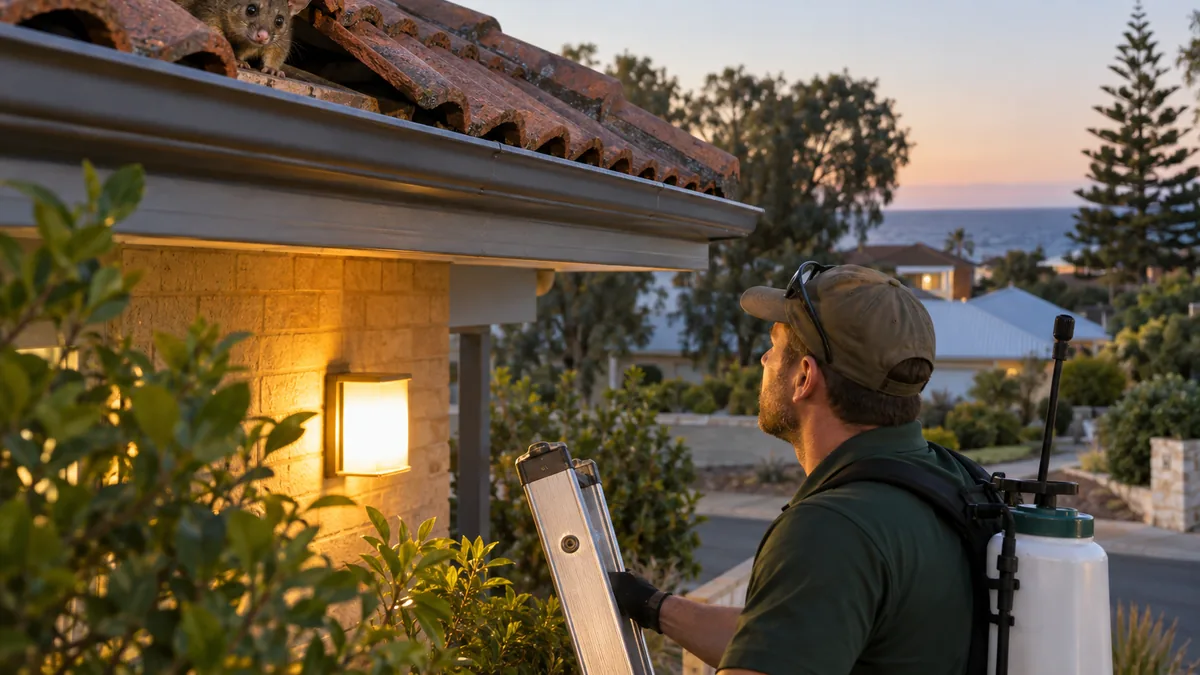
The common brushtail possum is the one in your roof. It is about the size of a cat, grey or silver with a bushy dark tail, and it is a confident animal that will use a roof void as a den because it is dry, dark and safe from owls and foxes. Brushtails are solitary, territorial and loud.
The western ringtail possum is smaller, with a thin tapering tail with a white tip, and it builds dreys, nests of leaves and bark, in dense vegetation such as peppermint trees. It is listed as a threatened species and is found in the south-west, including parts of the Peel region around Mandurah. Ringtails are far less likely to be in a roof, and if one is found the handling needs even more care.
The signs
Heavy thumping at night. Possums leave the roof at dusk and return before dawn. The noise is a thud and a heavy walk, not a scurry. During the day the roof is quiet, because the possum is asleep.
Scratching and scrambling at dusk. As the possum wakes and heads for its exit, you hear it move along the ceiling joists and out through the gap, often in the same place each evening.
Urine stains and smell. A possum using the same spot in the roof void for weeks leaves a yellow-brown stain on the ceiling plaster and a strong ammonia smell. On a hot Perth afternoon the smell is hard to miss.
Droppings. Possum droppings are dark, cylindrical and roughly the size of an olive. Rat droppings are far smaller, like grains of rice.
Damage. Torn insulation, chewed wiring and displaced tiles where the animal comes and goes.
Why possums get into roofs
Possums are climbers, and roof voids are a substitute for the tree hollows that suburbs no longer have. The entry is usually one of a few places. A broken or lifted roof tile, particularly on older brick and tile homes in Kelmscott, Armadale and Safety Bay. A gap at the eaves where the fascia meets the roof, or where a Colorbond roof is not sealed at the ridge or the gutter line. A vent, a whirlybird base or an old evaporative cooler penetration. And, more than anything else, a palm frond, a bougainvillea or a tree branch resting on the roof, which is the ladder.
In Armadale and Kelmscott, the jarrah and marri bushland on the scarp is the possum’s home range, and the big blocks with mature trees against the house give it a direct route to the roof. Along the coast, the palms and peppermint trees that suit the beachside suburbs do the same job.
What WA law allows
Possums, both brushtail and ringtail, are protected native fauna in WA under the Biodiversity Conservation Act 2016. That sets the boundaries for everything that follows.
They cannot be killed, poisoned or harmed. Baiting a roof void for a possum is an offence, and it is also dangerous, because a poisoned animal can die in the ceiling.
Trapping requires a licence. The Department of Biodiversity, Conservation and Attractions (DBCA) regulates who can trap and handle native fauna, and a licensed operator is the only lawful route if the animal has to be caught.
A trapped possum is released on the same property, close to where it was caught, at dusk. It is not taken to bushland, a park or the other side of the freeway.
Why relocating a possum far away is illegal and does not work
Relocation is prohibited because possums are territorial, and a released animal in unfamiliar country has no den, no known food sources and a resident possum that will fight it. Most relocated possums do not survive long, which is why DBCA does not permit it.
It also does not fix your roof. The territory does not stay empty. A vacant den with an open entry is found by the next possum in the area within days or weeks, and you are back where you started, minus one animal. The only thing that stops the cycle is closing the entry, which is why a proper possum removal is mostly carpentry and roofing, not trapping.
The trap is the smallest part of the job. The possum leaves for good when the roof is sealed, a box is on the tree and the branch that was the ladder is cut back.
How removal works
Inspection. The technician confirms it is a possum and not a roof rat, finds the entry point or points, checks the roof void for a nest or young, and looks at the trees and structures the possum is using to get on the roof. Timing matters, because a female brushtail can have a joey in the pouch or on her back through much of the year, and a joey left behind in a sealed roof is the outcome everyone wants to avoid.
Exclusion or trapping. Where the entry is a single known point, a one-way door is fitted so the possum can leave at dusk but cannot return. Where the layout does not allow that, a cage trap baited with fruit is set in the roof void or at the entry, checked every morning, and the animal is released on site at dusk. Both are done under the operator’s licence.
Sealing every entry point. Tiles are replaced or refixed, the gap at the eaves is closed with mesh or timber, vents are screened and the ridge or gutter line on a metal roof is sealed. Every gap, not just the one in use, because the possum will test the rest.
A possum box. A nest box is fixed to a tree on the property, away from the house, so the animal has a den and does not spend the next month looking for another way into the roof. Overhanging branches and palm fronds are trimmed back so the roof is no longer reachable.
The roof void is then checked for soiled insulation and any damage to wiring, and you are told what needs a separate trade.
When it is rats, not possums
A good share of possum calls turn out to be roof rats. Roof rats are excellent climbers, use the same palms and vines, and are active all night in the roof, but the sound is lighter and more continuous: scurrying, gnawing and a patter rather than a thud. Their droppings are small, and you may find gnawed fruit under the trees. Winter, from May to August, pushes rats indoors in every suburb from Hamilton Hill to Byford.
If that is what you have, the answer is a rodent control visit, with tamper-resistant bait stations or traps and the same attention to sealing the entry points. Near bushland and wetlands the technician may prefer traps, because owls and raptors that eat a poisoned rat can be poisoned in turn. Rodenticide use and pest management technician licensing in WA are overseen by the WA Department of Health. If you are not sure which animal it is, say so when you call, because the inspection will tell you.
Foothills and coast: what to expect
In the Darling Scarp suburbs, possums are simply part of the neighbourhood, and the aim is to keep them in the trees rather than the ceiling. Along the coast in Rockingham, Shoalwater and Mandurah, the calls are usually a single animal using a palm or a peppermint against the roof of an older home. In both cases the process is the same: confirm the animal, find the entry, remove it lawfully, seal the roof and give it somewhere else to live. Ask for a written quote first, and see WA Consumer Protection for your rights. The possum removal page sets out what is included and what to have ready when you enquire.
Questions on this topic
1. Is it legal to remove a possum from my roof in WA?
Yes, if it is done lawfully. Possums are protected native fauna under the Biodiversity Conservation Act 2016, so they cannot be harmed, poisoned or killed. Trapping needs a licence regulated by DBCA, and a trapped possum must be released on the same property, close to where it was caught. The lawful route is a licensed operator who removes the animal, seals the roof and provides an alternative den.
2. Can a possum be relocated to bushland instead?
No. Relocating possums away from the property is not permitted, because a possum released into unfamiliar territory has no den, no food sources and a resident possum to fight, and most do not survive. It also does not solve the problem, because another possum finds the empty roof within weeks. The animal is released on site at dusk and the roof is sealed so it cannot get back in.
3. How do I tell a possum from a rat in the roof?
Timing and weight. A possum leaves at dusk with a heavy thud and returns before dawn, and the roof is quiet by day. Roof rats are active on and off all night with a lighter scurrying and gnawing sound. Possum droppings are dark and olive-sized, rat droppings are the size of rice grains. A strong ammonia smell and a ceiling stain point to a possum using one spot for weeks.
4. What is a possum box and why is one installed?
A possum box is a timber nest box fixed to a tree on the property, away from the house. Suburbs have few tree hollows, which is why possums take to roof voids in the first place. Once the roof is sealed, the box gives the animal a dry den in its own territory so it settles rather than spending weeks testing the roof for another way in.
5. Will the possum come back after the roof is sealed?
Not into the roof, if every entry point has been closed and the branches or palm fronds it used as a ladder have been trimmed back. It will stay in the area, because it is territorial and that is allowed, and it will use the possum box if one has been installed. What brings possums back is a single gap left open, which is why the whole roof is checked rather than only the hole in use.