Wasps and bees are the pest calls that come with a sense of urgency, because someone has been stung or is about to be. From the foothill blocks of Kelmscott and Byford to the beachside streets of Safety Bay and Secret Harbour, spring brings honey bee swarms on fences and cars, summer brings paper wasp nests under every eave, and a hive that moved into a wall cavity in October is dripping honey through the plaster by February. This page explains how to tell the insects apart, what wasp control in Perth involves, when bees are relocated rather than treated, why a hive in a wall is more than a spray job, what to do about European wasps, and why native bees should be left alone.
Wasp or bee? Identify it before anyone acts
Honey bees are fuzzy, golden-brown and thick-bodied, and they fly with a heavy, slower movement. Paper wasps are slender with a narrow waist, long dangling legs and a reddish or yellow-and-black body, and they hover around the nest under the eave. European wasps are bright yellow and black, short-legged, fast and direct in flight, and they go after meat, sugary drinks and pet food at a barbecue. Mud daubers are slim with a very thin waist and build mud tubes on brickwork and under verandahs; they are harmless and rarely need anything done.
The identification matters because the response is different for each. A bee swarm may be collected by a beekeeper. A paper wasp nest is treated and removed. A suspected European wasp is reported to DPIRD. A native bee is left alone. A clear photo sent with the enquiry often lets the technician tell you which one you have before the visit.
Paper wasps under eaves, pergolas and meter boxes
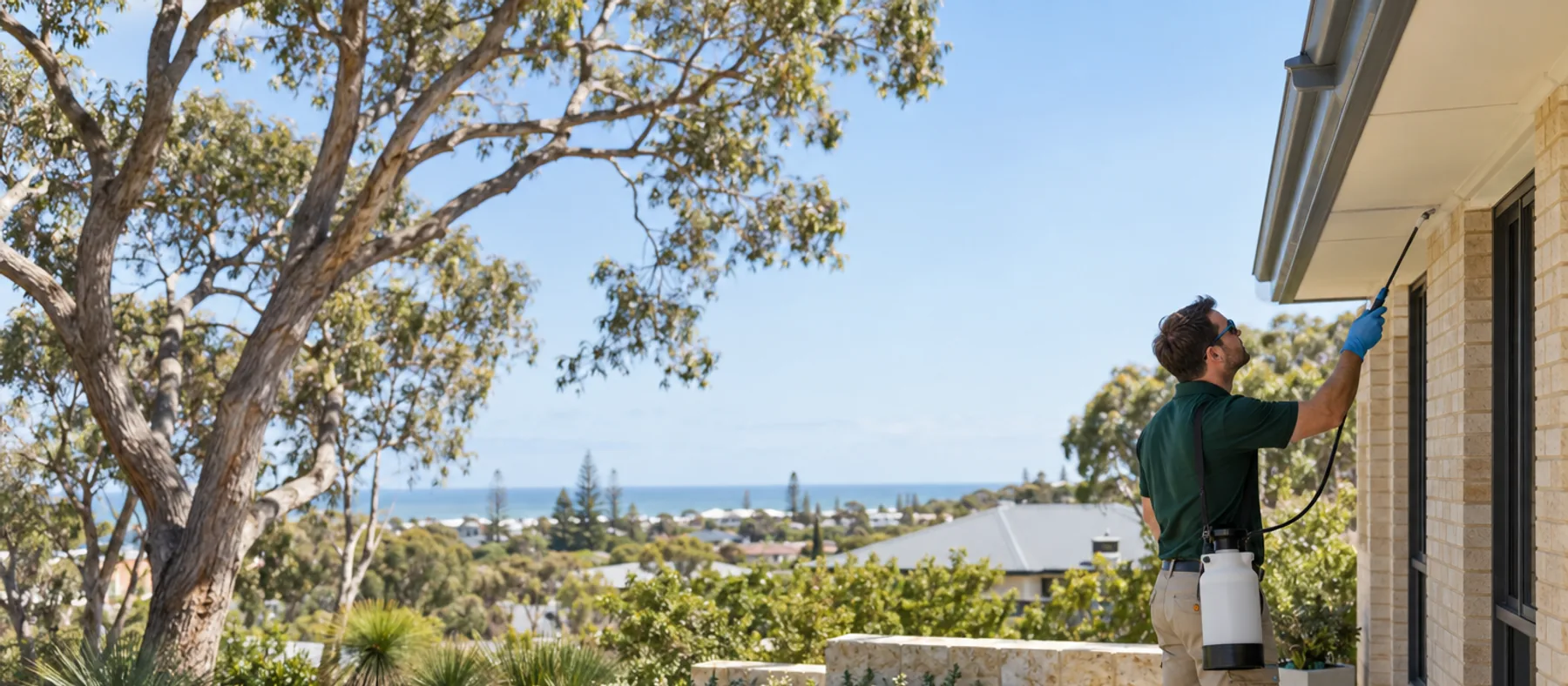
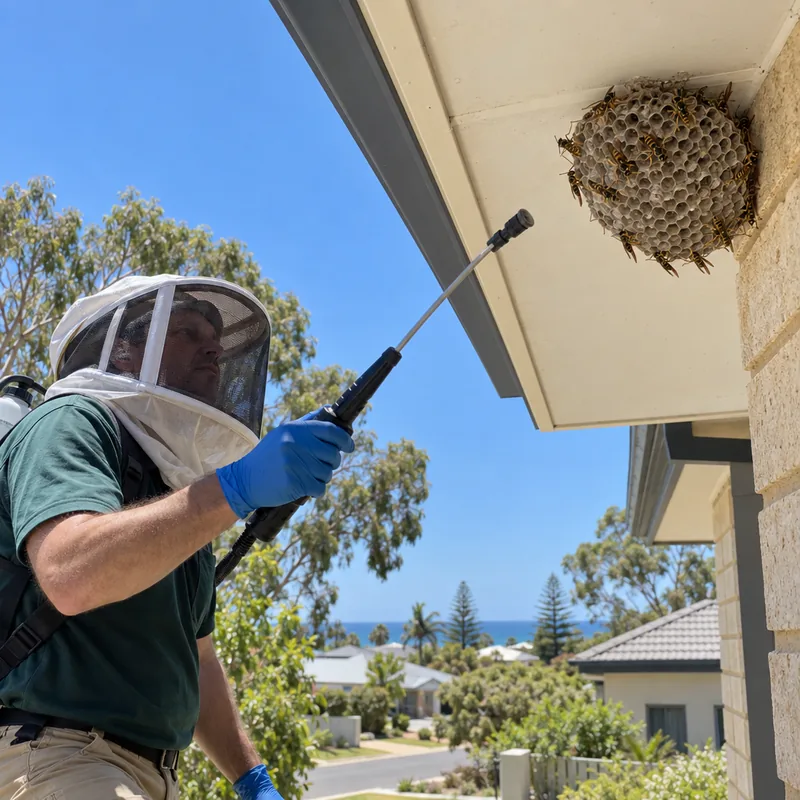
Paper wasps build small grey combs shaped like an upside-down umbrella, hanging from a single stalk under eaves, pergola beams, gutter brackets, letterboxes, meter box lids, outdoor furniture and children’s play equipment. In the double-brick estates of Secret Harbour, Baldivis and Port Kennedy a single house can have half a dozen nests by late summer. The wasps are not aggressive away from the nest but defend it hard, and most stings happen when someone is cleaning gutters, pruning, mowing under the eave or opening a meter box.
Treatment is direct: the nest is treated with an insecticide, the wasps die and the comb is removed so it does not attract a new queen. Where a property gets nests every year, a residual treatment of the eave line as part of a general pest control treatment reduces how many establish the following spring.
European wasps and DPIRD
The European wasp is established in WA and is a serious pest: the nests are usually underground or inside a wall or roof cavity, they can hold thousands of wasps by autumn, the wasps sting repeatedly and they swarm anyone who disturbs the nest. The Department of Primary Industries and Regional Development (DPIRD) runs a reporting and eradication programme, including the Adopt-a-Trap scheme, and asks the public to report suspected sightings with a photo and location rather than attempting to deal with the nest themselves.
If the technician identifies European wasps on a job in Rockingham, Kwinana or Armadale, the sighting is reported to DPIRD and you are told how to do the same. Do not pour petrol down the hole, do not block the entrance and keep children and pets away until the department or a licensed operator has dealt with it.
Honey bee swarms in spring
A swarm is a colony on the move. In spring a strong hive splits, the old queen leaves with half the workers, and the cluster settles on a branch, a fence post, a car mirror or the side of a shed while scout bees look for a permanent home. It looks alarming, but a resting swarm is usually docile because the bees have no comb or young to defend.
Where the swarm is accessible and has only just settled, the right outcome is for a beekeeper to collect it into a box and take it away, and we refer swarms on for bee swarm removal where that is practical. Swarms that have moved into a cavity, are out of reach or pose an immediate risk to someone with an allergy may need to be treated instead. European honey bees are not protected in WA, but relocating a healthy swarm is the better result when it can be arranged, and bee control in Perth should start with that question.
Hives in wall cavities, roof voids and chimneys
The difficult jobs are the ones where the swarm found a home in the house. Scout bees like a dry cavity with a small entrance: a weep hole in double brick, a gap under the roof tiles, a chimney, a Colorbond flashing gap, an unused compost bin or a hollow in a tuart on the verge. Within weeks the colony has built comb fixed to the studs or the brickwork, and by the end of a Rockingham summer it can hold a large amount of honey.
Treating the entrance kills the colony but leaves the comb. Without bees fanning it, the honey runs down inside the cavity in the heat, stains the plaster, and draws ants, cockroaches, wax moth and the next spring’s scout bees, who can smell an old hive site. Bee hive removal done properly means treating the colony, opening the wall, ceiling or chimney to cut out the comb, cleaning the cavity and sealing the entrance and nearby gaps. The quote says plainly whether the comb needs to come out and how the wall will be opened and made good. A hive in a roof void is sometimes found while looking for something else, and the possum removal page covers the other regular occupant of Kelmscott and Byford roof voids.
Native bees are not a pest
WA has hundreds of native bee species and almost all of them are solitary, stingless or very reluctant to sting. Blue-banded bees nesting in a limestone or mud wall, resin bees in a bamboo stake, leafcutter bees taking neat circles out of rose leaves, and the small stingless colonies people keep in hives are pollinators, not pests. They do not build large colonies inside wall cavities and they do not need treating. If a photo shows native bees, the honest advice is to leave them be, and the technician will say so.
Safety, licensing and a written quote
Wasp and bee work is done by technicians holding a WA Department of Health Pest Management Technician licence, and you are welcome to ask to see it. Nests near a play area, a school pick-up point or a business entrance are prioritised in the schedule, and the treatment is planned around when the insects are least active. The quote is written before any treatment and covers the treatment, the removal and, for a hive, the comb question. The post on what changes a pest control quote in Perth explains the factors. For a wasp exterminator or bee removal anywhere from Cockburn to Mandurah and out to Kelmscott, use the quote form or call, and you will be contacted to arrange a time.
What is included
- Identification of the insect first: paper wasp, European wasp, mud dauber, honey bee swarm, established hive or native bee
- Paper wasp nests under eaves, pergolas, gutters, meter boxes and play equipment treated and removed
- Honey bee swarms assessed and referred to a beekeeper for collection where practical, or treated where relocation is not possible
- Established hives in wall cavities, roof voids, chimneys and compost bins treated, with advice on opening the wall to remove the comb
- Comb and honey removal coordinated so the cavity does not attract ants, cockroaches, wax moth and the next swarm
- Entry points sealed after the hive is dealt with so scout bees do not re-establish in the same cavity
- Suspected European wasp sightings reported to DPIRD as part of the state programme
- Written quote before any treatment, with the technician's licence available on request
Signs you should call
- A small grey papery nest shaped like an upside-down umbrella under the eaves, pergola or letterbox
- A hanging cluster of thousands of bees on a branch, fence or car in spring
- A steady stream of bees going in and out of a weep hole, a gap in the brickwork or under the roof tiles
- Honey staining or a sticky patch on an internal wall or ceiling in summer heat
- Yellow and black wasps with a fast flight and short legs that are attracted to meat, pet food and drinks
- Wasps or bees near a kids' play area, a school pick-up spot or a workplace entrance
- Someone in the household with a known sting allergy and a nest anywhere on the property
Wasp & Bee Removal in four steps
Inspect
The technician identifies the species and finds the nest, swarm or hive entrance, and checks whether the colony is established behind a wall or roof. This decides whether it is a treatment, a beekeeper relocation or a DPIRD report.
Written quote
You get a written quote for the treatment and, for a hive in a wall, an honest note about whether the comb needs to be removed and by whom. Nothing is treated until you agree.
Treat
Paper wasp nests are treated and removed; hive entrances are treated with an insecticidal dust or spray and the bees allowed to die off inside. Swarms that can be collected are left to the beekeeper.
Protect and follow up
Once the colony is dead, the entrance is sealed and the cavity is checked for comb that needs to come out. You are told what to watch for in spring, when scout bees return to old sites.
Keep kids and pets well clear, and do not seal the hole yourself
Do not block the entrance to a nest or hive before it is treated; the insects will chew their way into the house through the nearest gap, often a light fitting or an air vent. Keep children and pets inside with windows shut during the treatment and until the technician says the area is clear. Anyone in the household with a known sting allergy should stay away from the nest area entirely and have their medication to hand. Never spray a nest with a garden hose or knock it down at night with a torch; that is how most sting incidents happen.
Frequently asked questions
1. How do I tell a wasp from a bee?
Honey bees are fuzzy, golden-brown and thick-bodied, and they fly with a heavier, slower movement. Paper wasps are slender with a narrow waist, long dangling legs and a reddish-brown or yellow-and-black body, and they build small open combs under eaves. European wasps are bright yellow and black with short legs and a fast, direct flight, and they are attracted to meat, sugary drinks and pet food. Mud daubers are slim with a very thin waist and build mud tubes on walls; they are harmless. If you can send a clear photo, the technician can usually identify it before the visit.
2. What should I do if I think I have seen a European wasp?
Do not disturb it. European wasps are established in WA and the Department of Primary Industries and Regional Development (DPIRD) runs a reporting and eradication programme that includes the Adopt-a-Trap scheme. Sightings should be reported to DPIRD with a photo and location, because the department maps and treats nests as part of that programme. We report suspected sightings we come across in Rockingham, Kwinana and Baldivis and will tell you how to do the same. The nests are usually underground or in a wall cavity and can hold thousands of very aggressive wasps, so this is not a job for a can of spray.
3. Can the bees be relocated instead of killed?
Often, if it is a swarm. A swarm is a cluster of bees resting on a branch, fence or post while scouts look for a new home, and a beekeeper can usually collect it into a box soon after it settles, where access allows. We refer swarms on where that is practical. An established hive inside a wall cavity or roof void is different: the comb is fixed to the structure and cutting it out means opening the wall, so relocation is rarely possible and the colony is treated. European honey bees are not protected in WA, but relocating a swarm is the better outcome where possible.
4. Bees are going into a gap in my brickwork. Can you just spray the hole?
The entrance can be treated and the colony killed, but that is only half the job. A hive that has been in a Rockingham wall through one summer can hold a large amount of comb and honey. Once the bees die there is nothing to keep the honey cool, it runs down inside the cavity, and it attracts ants, cockroaches, wax moth and the next swarm. The comb usually needs to be removed by opening the wall or ceiling, and the cavity cleaned before it is sealed. The quote says whether that is needed in your case.
5. Are native bees a problem?
No. WA has hundreds of native bee species, most of them solitary and stingless or very reluctant to sting. Blue-banded bees nesting in a mud-brick wall, resin bees in a bamboo stake or a hole in the fence, and leafcutter bees cutting neat circles from rose leaves are all harmless and useful pollinators. They do not build large colonies in wall cavities and do not need treatment. If you are unsure what you have, a photo to the technician settles it, and if it is native bees the honest answer is to leave them alone.
6. When are wasps and bees most active in Perth's south?
Spring is swarm season for honey bees, when a strong colony splits and the old queen leaves with half the workers to find a new home, which is why swarms appear on fences and cars in Safety Bay and Secret Harbour from September onwards. Paper wasps start small nests in spring and the nests are at their largest by late summer, which is when most stings happen while people are mowing, pruning or cleaning gutters. European wasp numbers peak in late summer and autumn. Winter is the quiet period, and the best time to seal gaps in the brickwork before the next season.
7. Is it safe for kids and pets during a wasp nest treatment?
Yes, with a bit of planning. Children and pets stay indoors with windows closed while the nest is treated and until the technician confirms the area is clear, because disturbed wasps defend the nest for a short time. The products used are applied directly to the nest or hive entrance rather than broadcast across the yard, so there is little residue elsewhere. For a paper wasp nest over a sandpit or swing set, the nest is removed as well as treated. Anyone with a known sting allergy should stay well away and keep their prescribed medication to hand.